How Many Lumens Does a Living Room Need? A Calculation by Room Size
For general living room lighting, aim for 100 to 200 lumens per square metre, or roughly 10 to 20 lumens per square foot. For a 20 m² (215 sq ft) living room that means 2,000 to 4,000 lumens across all the lamps in the room. A reading corner needs 300 to 500 lux on the page on top of that, which comes from a floor or table lamp next to the reader rather than the ceiling light.
Lumens and lux: two different measures
Lumens are the total amount of light a lamp gives out, printed on the bulb box. Lux is the intensity of light falling on a surface: lumens per square metre. If 100 lumens fall on 1 m², that surface has 100 lux.
So the recommended 100 to 200 lux for a living room equals, in ideal conditions, 100 to 200 lumens per square metre.
Calculation table
| Room size | Soft evening light (100 lm/m²) | Bright, multi-purpose (200 lm/m²) |
| 12 m² (130 sq ft) | 1,200 lumens | 2,400 lumens |
| 16 m² (170 sq ft) | 1,600 lumens | 3,200 lumens |
| 20 m² (215 sq ft) | 2,000 lumens | 4,000 lumens |
| 25 m² (270 sq ft) | 2,500 lumens | 5,000 lumens |
| 30 m² (325 sq ft) | 3,000 lumens | 6,000 lumens |
The formula: area x target lux = total lumens needed. In feet: square feet x target foot-candles.
Why a real room needs more
The table assumes all the light from the lamps reaches the room evenly. In reality some is lost in shades, dark walls, dark ceilings and furniture. Add 25 to 50 percent to your figure if:
- walls or ceiling are dark
- most lamps have fabric or opaque shades
- the ceiling is higher than 3 m (10 ft)
- the room is dominated by light-absorbing surfaces such as dark wood or dark upholstery
Do not put all the lumens in one lamp
Getting 4,000 lumens from one ceiling fitting is technically possible, but the room looks flat, shadowless and harsh. Splitting the light into layers works better:
- General light: the ceiling fitting, about half of the total
- Ambient light: a floor lamp in a corner, bouncing soft light off walls and ceiling
- Task light: a separate lamp at the reading spot
Which layer a floor lamp takes on depends on where it stands: behind the shoulder of a reading chair for task light, in a corner for ambient light. Measurements are in where should a floor lamp go.
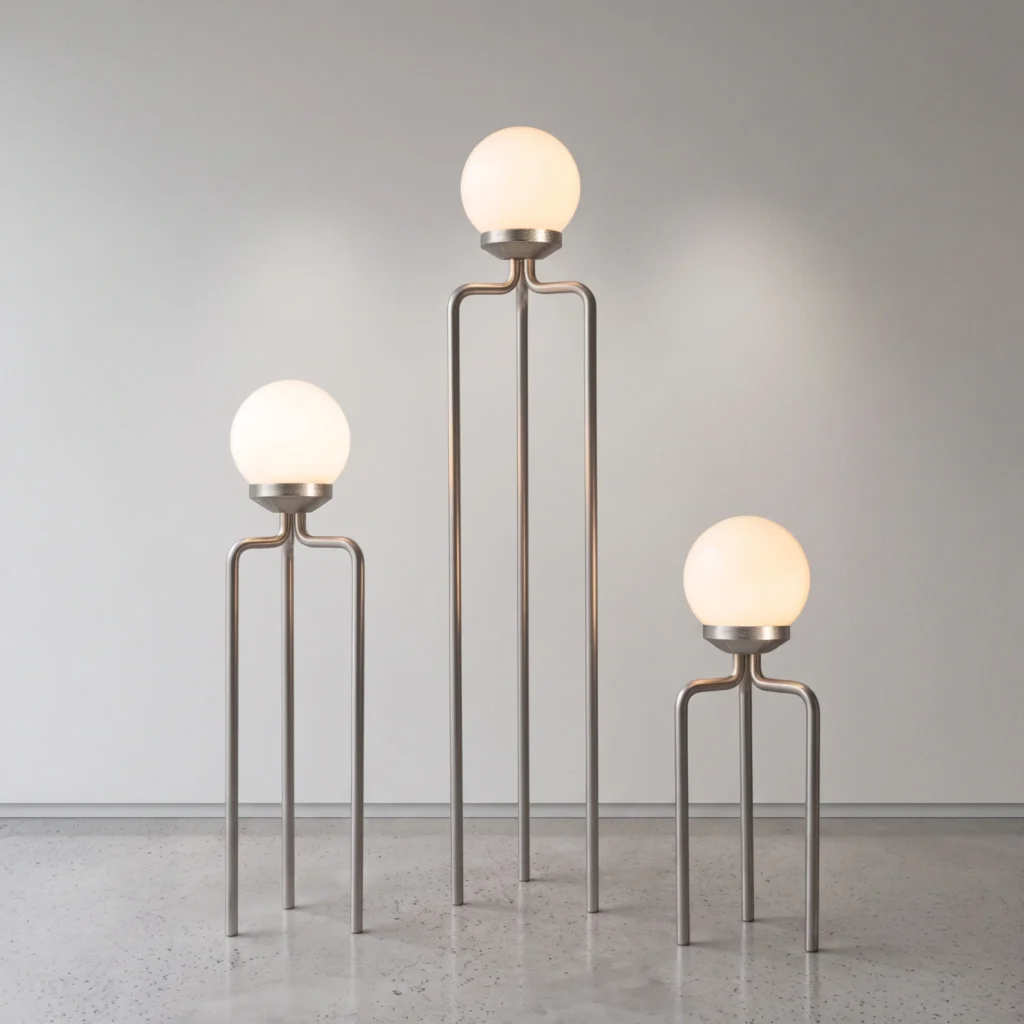
Globe fittings spread light in every direction, which makes them good ambient sources. The three globes of the Trio Floor Lamp sit at different heights and spread light across different levels of the room.
For a reading corner
Reading needs 300 to 500 lux on the page, more for small print and long sessions. General living room light is only about a third of that, so reading light always comes from a separate lamp, and how close the lamp is matters more than how strong it is. Light falls off with the square of distance: move a lamp twice as far away and the light on the page drops to a quarter.
Lumens, not watts
With LED bulbs, watts tell you energy use, not light output. Compare the lumen figure on the box. Rough equivalents of old incandescent bulbs:
| Old incandescent bulb | Approximate light |
| 40 W | 450 lumens |
| 60 W | 800 lumens |
| 75 W | 1,100 lumens |
| 100 W | 1,600 lumens |
For evenings, warm white light between 2700 and 3000 Kelvin suits a living room. Dimmable lamps make it easy to have both a bright and a soft setting in the same room.
Frequently asked questions
How many lumens for a 20 m² living room?
2,000 to 4,000 lumens in total. Add 25 to 50 percent for dark walls or mostly shaded lamps.
What is the difference between lux and lumens?
Lumens are the total light a lamp emits. Lux is the intensity of light on a surface, lumens per square metre.
How many lux do I need to read?
300 to 500 lux on the page, about three times general living room light, provided by a separate lamp beside the reader.
What colour temperature suits a living room?
Warm white, 2700 to 3000 Kelvin, for evening use. Cooler light (4000 Kelvin and above) is better for work areas.
Sources: U.S. Department of Energy, Lumens and the Lighting Facts label