What Is Small-Batch Production? One-Off vs Batch vs Mass Production
Small-batch production means making a product neither one at a time nor by the thousand, but in runs of tens to a few hundred. Because it relies on methods that need no expensive tooling, such as laser cutting, bending and welding, it stays open to design changes, custom sizes and custom colours. Unit cost is higher than mass production and lower than one-off production.
Three ways to make things
| One-off | Small batch | Mass production | |
| Quantity | One or a few | Tens to a few hundred | Thousands and up |
| Tooling investment | None | None or very low | High |
| Unit cost | Highest | Medium | Lowest |
| Design changes | Possible on every piece | Possible between batches | Hard without new tooling |
| Custom size and colour | Fully open | Open | Usually closed |
| Stock | None | Little | Large |
These lines are not sharp. The method used decides which category a product falls into as much as the quantity does.
Why tooling decides
A plastic chair is made with an injection mould, an aluminium part with a die-casting mould. These tools are very expensive and only make sense when their cost is spread over thousands of units. Once made, changing the design almost means a new tool.
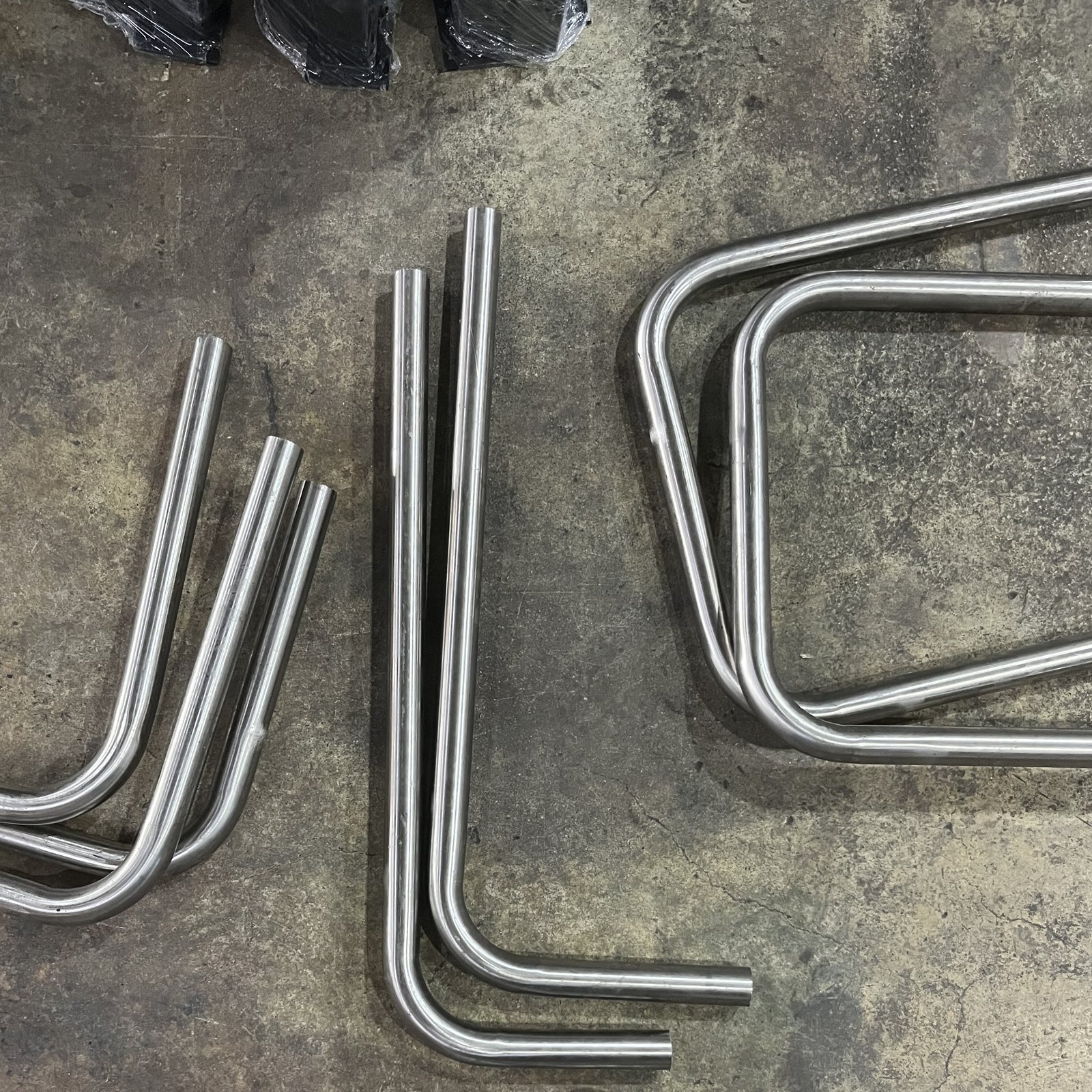
Furniture made from stainless steel tube and plate is different. Parts are laser cut, bent on a press brake or tube bender, and joined by welding. Most of these steps need no expensive product-specific tool; giving the machine a new dimension or program is enough. That is why metal furniture is a natural fit for small batches.
Advantages of small batches
- Flexibility. An improvement spotted in one batch can go into the next.
- Custom size and colour. A table resized for a project, or a chair coated in the project’s RAL code, can be made without disrupting production.
- Less stock. Less capital and material tied up in warehouses and unsold goods, and less overproduction.
- Local production. Small runs can be made in nearby workshops without long supply chains.
Disadvantages
- Unit cost. Set-up and hand work are spread over fewer units, so the price per piece is higher than mass production.
- Lead time. Products often come from production rather than stock. Cohoo products are made to order, so there is no stock and the lead time is 20 working days.
- Dependence on workmanship. Quality depends more on the skill of the maker and the checks than on the machine. Welding is where this shows most clearly; what to look for is in what welds reveal about metal furniture quality.
Who is it for?
Small-batch production suits interior design projects particularly well. A hotel, office or residential project often needs tens of the same piece, but usually in a project-specific size or colour. Mass production does not offer that flexibility, and one-off production makes that quantity expensive. Working with interior designers is covered in custom furniture for interior designers, and a product’s steps in the workshop in how a chair is made in the workshop.
Cohoo products are designed at Cohoo and made to order in Turkey from stainless steel.
Frequently asked questions
How many units is a small batch?
There is no fixed threshold. Runs of tens to a few hundred are usually called small batches. Whether the product needs expensive tooling matters more than the exact number.
Why is small-batch production more expensive per piece?
Machine set-up, checks and hand work are spread over fewer units, so unit cost is higher than in mass production. In return, it needs no tooling investment.
What is the main difference between batch and mass production?
Mass production makes thousands with expensive tooling at low unit cost, but design changes are hard. Small-batch production makes fewer without tooling at a higher unit cost, but stays open to design and size changes.
Can custom-size furniture be made in small batches?
Yes. In tooling-free metal furniture production, a size change often only means changing cutting and bending dimensions.