What Welds Reveal About Metal Furniture Quality
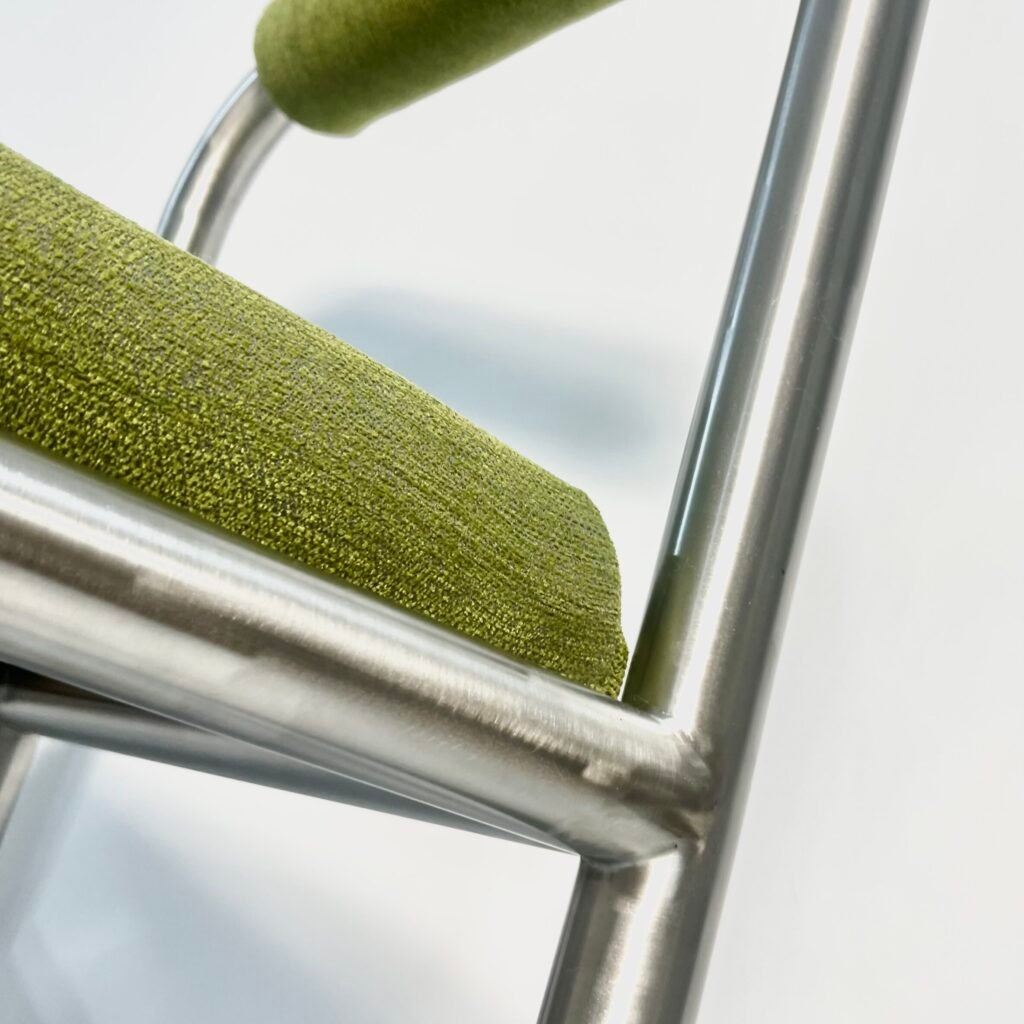
On a well-made stainless steel piece, a weld is either invisible or shows as a neat, continuous seam with the heat discolouration removed. Blue, purple or grey colour left around a weld, irregular blobs, pinholes and grinding marks that shine differently from their surroundings all show that the workmanship or the surface treatment was not finished. The weld is the part of a metal piece that tells you the most, because it affects both strength and corrosion resistance.
What the colours around a weld mean
During welding the metal gets very hot and a thin oxide layer forms around the joint, showing rainbow-like colours. The colour shows how hot it got and how much the surface was affected. More importantly, this oxidation uses up chromium at the surface, and since chromium is what makes stainless steel stainless, corrosion resistance drops in that zone.
| Colour around the weld | Meaning | Pitting resistance retained (approx.) |
| None or very light straw | Well shielded or cleaned weld | 80 to 90 percent and above |
| Gold, brown | Noticeable oxidation | Falling |
| Blue, purple | Heavy oxidation | 40 to 60 percent |
| Grey, black | Very heavy oxidation | Can fall below plain carbon steel |
That is why good production does not leave weld colours in place. They are ground off mechanically or removed with acid (pickling), and the surface is then passivated again. Mechanical removal has to take off a few tens of microns to get below the chromium-depleted layer. How stainless steel builds this protective layer is explained in what happens when stainless steel stays wet.
Seven things to check on a weld
- Colour. No blue, purple or grey left around the weld.
- Continuity. A visible seam should be even in width and unbroken from end to end. A stop-start seam that thickens and thins suggests rushed work.
- Porosity. No pinholes in the seam. They weaken it and trap dirt and moisture.
- Spatter. Small metal droplets stuck around the weld should be cleaned off.
- Surface after grinding. If the weld was ground flush, that area should look like its surroundings. On a satin piece, the grain should continue through the weld zone in the same direction. A brighter or duller patch means the surface finish was left incomplete.
- Inside corners. Hard-to-see inside corners should be cleaned too. They are the first thing skipped in careless production.
- Flatness and balance. Welding heat pulls and distorts metal. A table that rocks on a flat floor or legs that are not parallel can be the result of heat that was not controlled.
Is a visible weld always bad?
No. In some designs the seam is left visible on purpose and becomes part of the design. Then it matters even more that it is neat, continuous and clean. The difference between a poor weld and a deliberate visible one shows up in the seven points above.
TIG or laser welding?
Two methods dominate in stainless steel furniture. TIG welding is done by hand with a tungsten electrode under shielding gas and gives a controlled seam with little spatter. In laser welding, heat is delivered by a focused beam to a very small spot: total heat input is low, the heat-affected zone stays narrow, the part distorts less and discolouration around the weld drops noticeably. Because the seam is narrow and even, less grinding and cleaning is needed afterwards.
Cohoo pieces are mostly laser welded. On parts made from thin tube and plate, that means joints heat up less and blend more easily into the rest of the surface.
The other production steps
Welding comes after cutting and bending and before surface finishing. How a chair goes through these steps is described in how a chair is made in the workshop.
Frequently asked questions
Does stainless steel rust at the weld?
If the heat tint is not removed, corrosion resistance drops there and staining can start, especially in damp places. A properly cleaned and passivated weld is as durable as the surrounding metal.
Is an invisible weld better?
Not always. An invisible weld needs good grinding and finishing. A neat visible seam can be high quality too. What matters is that colour, porosity and spatter have been dealt with.
Can blue weld colour be wiped off?
Not with household cleaning. It needs mechanical grinding or pickling and passivation, which belong in production.
What is laser welding?
Welding in which a focused laser beam delivers heat to a very small spot. Because little heat goes into the metal, distortion and discolouration around the weld are reduced and the seam is narrow and even. It is increasingly common on thin stainless steel parts.
Sources: TWI, Avoiding heat tint during welding of stainless steels; Euro Inox, Pickling and passivating stainless steel