What Happens When Stainless Steel Stays Wet?
Stainless steel does not rust because it gets wet. The problem starts in narrow gaps where water stands still and fresh air cannot reach: oxygen runs out, salts build up, and a local attack called crevice corrosion can begin. The spot where a plant pot or saucer sits flat on a stainless steel surface is the most typical example at home. The fix is simple: do not let water pool, and let the surface dry from time to time.
What protects stainless steel is oxygen
Stainless steel is stainless because of an invisible film, a few nanometres thick, that the chromium in the steel forms with oxygen in the air. When the film is scratched or damaged, it rebuilds itself within minutes as long as oxygen is present. Its protection is not a fixed coating but a reaction that keeps renewing.
That is why water is no threat to a stainless steel surface that gets wet and dries in open air. Rain, steam or a spilled glass does not harm it; oxygen is always there.
What changes inside a gap
In a narrow gap between two surfaces, such as under the base of a pot, water gets trapped and stops moving. In that thin film of water three things happen:
- The oxygen in the water is used up and not replaced, so the protective film can no longer repair itself.
- As water evaporates, the salts it carried stay behind and the chloride concentration keeps rising.
- The liquid slowly turns acidic and the attack speeds up.
The result is small brown marks or pits inside the gap while the rest of the surface stays bright. This is crevice corrosion, and it can start at lower salt levels than pitting on an open surface.
Why evaporation matters
Tap water contains chloride. The EU drinking water directive uses 250 mg per litre as its indicator value for chloride, and most city supplies are well below it. On their own, these levels are not a problem for stainless steel.
But every time water standing in a saucer or under a pot evaporates, it leaves its chloride behind. Weeks of watering, drying and watering again can push the salt concentration in the gap far above that of the tap water. Fertilisers that contain chloride speed this up.
How 304 and 316 differ here
The widely used Nickel Institute guidelines for stainless steel in water, at neutral pH and ambient temperature and already allowing for crevices, are:
| 304 | 316 | |
| Recommended chloride limit (in water) | about 200 mg/L | about 1,000 mg/L |
| Molybdenum | none | 2 to 2.5 percent |
| Pitting resistance equivalent (PREN) | about 19 | about 24 |
PREN is an index calculated from chromium, molybdenum and nitrogen content (% Cr + 3.3 x % Mo + 16 x % N). The higher it is, the more resistant the steel is to pitting and crevice corrosion. Our 304 vs 316 stainless steel post explains the difference in detail.
Indoors, with no source of salt, 304 is sufficient. What decides the outcome is not the grade but whether water is allowed to pool in a gap.
Risk at a glance
| Situation | Risk |
| Open surface that gets wet now and then and dries | Low |
| Plant caddy with an air gap, wets and dries | Low |
| Narrow gap under a saucer that stays damp | Medium |
| Constantly wet gap where fertilised water evaporates and leaves salt | High |
| Seaside, around a pool | High, 316 preferred |
What to do under plant pots
- Do not leave water in the saucer. Empty it about half an hour after watering.
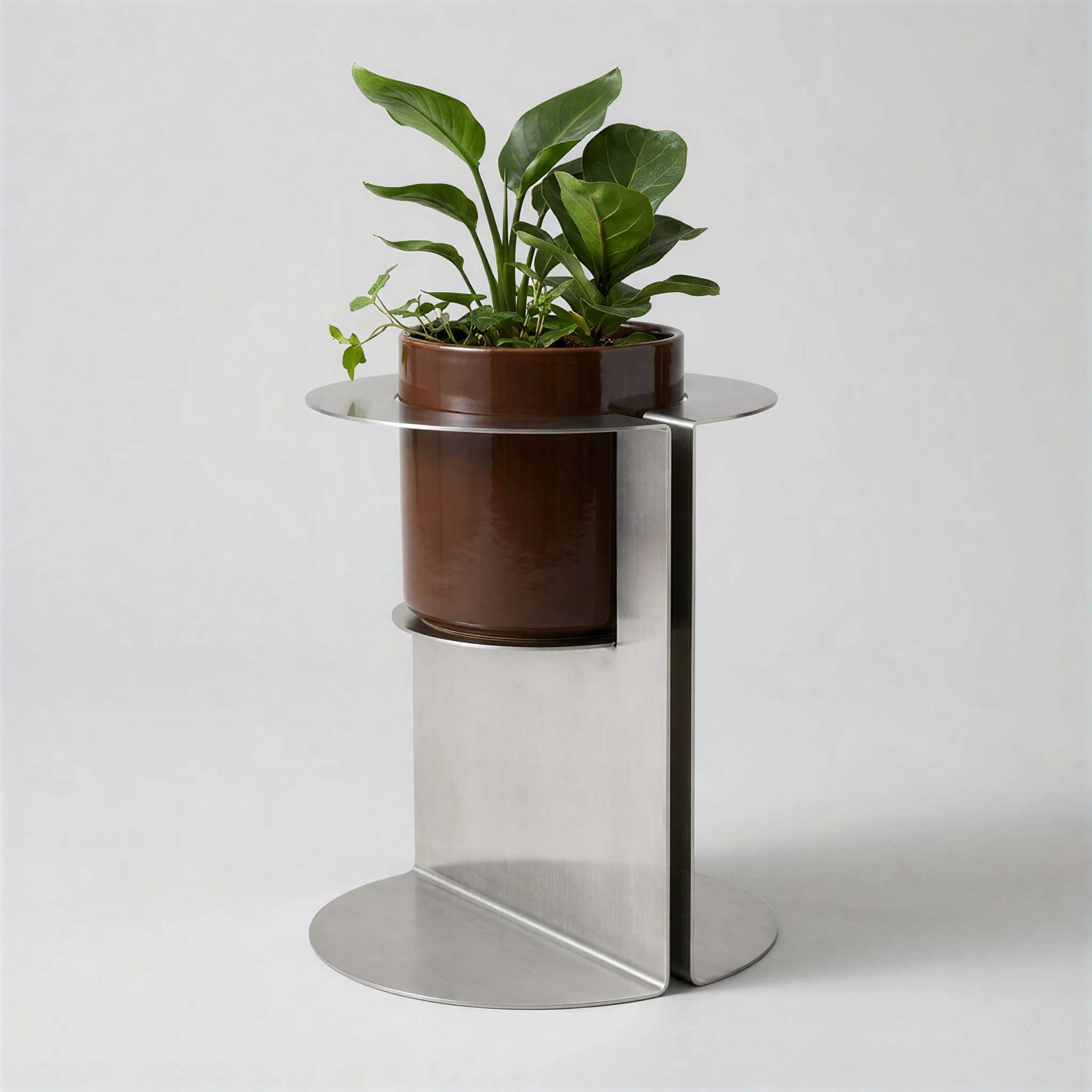
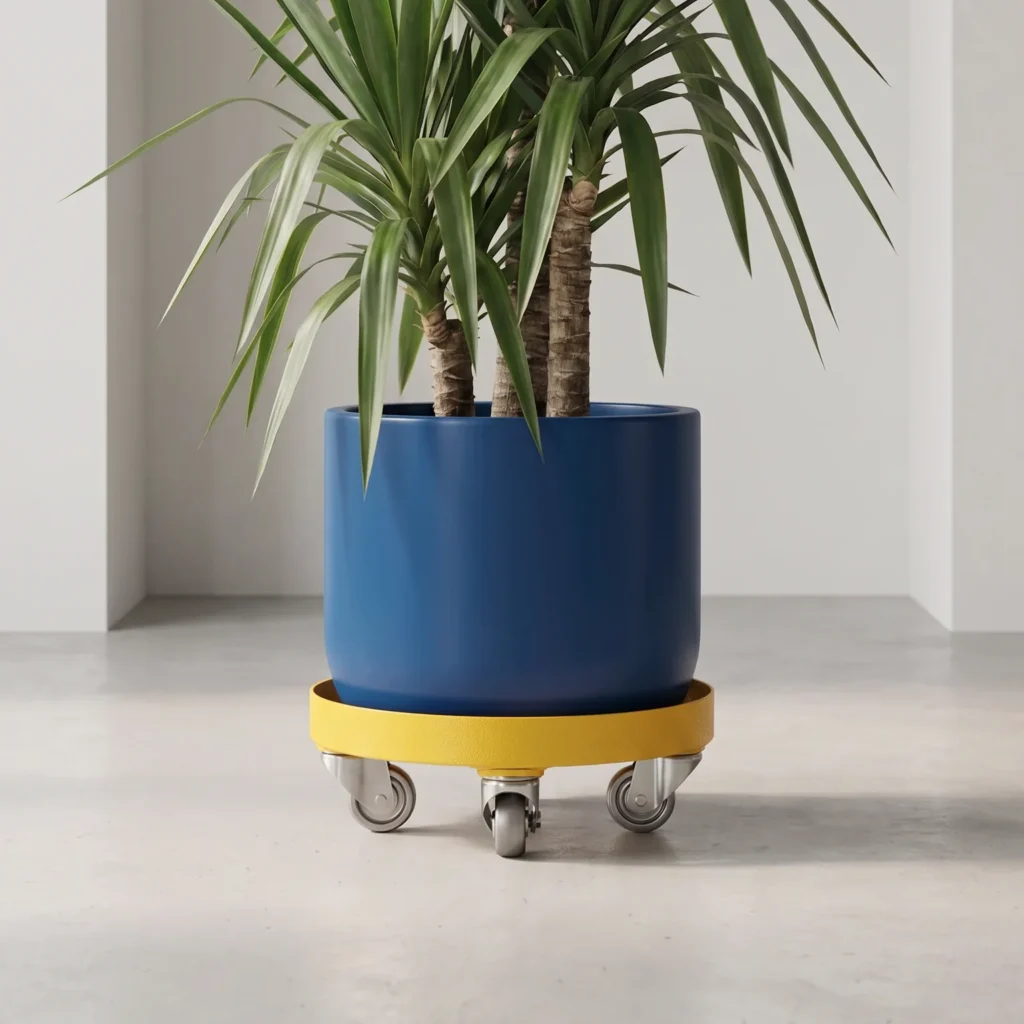
- Leave an air gap. Do not let the pot or saucer sit flat on the steel; let air pass underneath. Our post on protecting wood floors from potted plants explains why the same gap protects your floor.
- Rinse and dry once a month. Lift the pot, rinse the surface with clean water and dry it with a soft cloth. Built-up salt goes with it.
- Do not pour fertilised water on the steel. Feed into the pot and wipe up any overflow.
- Never use steel wool. The iron particles it leaves behind rust and the stain looks like the steel itself is rusting.
Extra precautions outdoors are in can stainless steel furniture be used outdoors, and the general cleaning routine is in stainless steel furniture care.
Frequently asked questions
Will stainless steel rust if I pour water on it?
No. Stainless steel that gets wet and dries in the open does not rust. The risk only appears when water stays still in a narrow gap for a long time.
There is a brown mark under my plant pot. What should I do?
Lift the pot, rinse the surface and wipe it along the grain with a stainless steel cleaner containing oxalic acid. Rinse well and dry. Surface stains come off this way.
Can stainless steel touch soil inside a pot?
It can, but soil is constantly damp and airless, which creates crevice conditions over time. Using the steel as an outer carrier around an inner pot, rather than in direct contact with soil, is safer.
Do I need 316 indoors?
Not unless there is a salt source such as the sea or a pool nearby. The real precaution is not letting water pool.
Sources: ASSDA, Chlorine and chloride: same element, very different effect; Nickel Institute, Resistance of stainless steel to corrosion in naturally occurring waters (No. 1262)