304 vs 316 Stainless Steel: What Is the Difference?
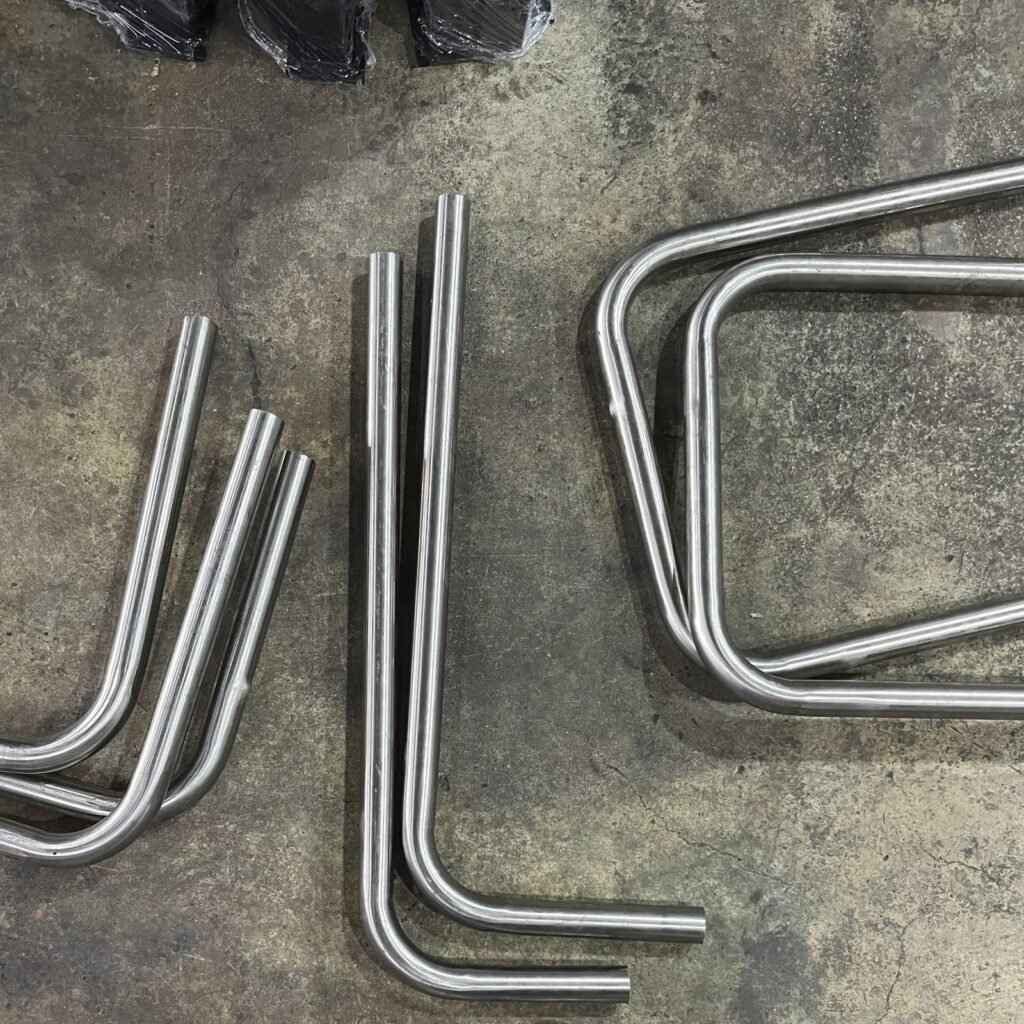
The decisive difference is molybdenum. 316 contains at least 2% molybdenum, 304 contains none. Molybdenum markedly improves resistance to chloride, meaning salt. Everything else, appearance, feel, cleanability and formability, is close enough to be indistinguishable in practice. Standing next to a finished piece of furniture, you cannot tell 304 from 316 by eye.
The composition difference
The table below gives typical European standard ranges. Under other standards such as ASTM the figures shift slightly, but the relationship the table describes does not change.
| Element | 304 | 316 |
|---|---|---|
| Chromium | 17.5% – 19.5% | 16.5% – 18.5% |
| Nickel | 8% – 10.5% | 10% – 13% |
| Molybdenum | none | 2% minimum |
| Carbon, silicon, manganese | effectively identical | |
Note the detail that surprises most people: 316 actually contains slightly less chromium. Its advantage does not come from chromium content. Molybdenum makes the protective film harder to break down under chloride attack, and helps it heal if a breach starts. The slightly higher nickel keeps the structure stable.
Why salt is the deciding factor
The chromium oxide film is not a uniform suit of armour. Chloride ions settle on its weak points and puncture it over a very small area. Once punctured, corrosion does not spread across the surface, it drives downward, producing the pinhole-like damage known as pitting corrosion. A mark almost invisible on the surface can progress inside the material.
Molybdenum makes exactly that initiation harder. This is why 316 is the default in marine, chemical and coastal architectural work, and why it also appears in medical implants and laboratory equipment.
Where each grade belongs
| Typical for 304 | Typical for 316 |
|---|---|
| Home and office furniture | Coastal outdoor furniture |
| Kitchen equipment, cutlery | Pool surround hardware |
| Indoor architectural cladding | Boat fittings |
| Heat exchangers, food processing | Chemical and petroleum equipment |
| Fasteners | Medical implants, laboratories |
Is the cost difference real?
Yes. Molybdenum is an expensive element and 316 also carries more nickel. Together they make 316 noticeably more expensive than 304 of the same thickness. So specifying 316 is not automatically the better decision. Choosing 316 for a side table that will live indoors is like using marine paint in a living room: it does no harm, but the premium buys nothing.
How to decide for furniture
Three questions are enough. Will the piece face salt-laden air or chlorinated water regularly? Will moisture stand on the surface for long periods? Will cleaning involve salt or chlorine based products? If the answer is no to all three, 304 is the correct and sufficient choice.
Cohoo builds its bodies in 304 stainless steel because these pieces are designed for interiors. Mobo Bar Stool lives beside a kitchen island at a 65 cm seat height, Move Chair around a dining table at 44.5 cm. Neither environment carries a chloride load anywhere near the limits of 304. If you want the underlying chemistry first, our guide to what stainless steel is covers it.
Frequently asked questions
Does 316 scratch less?
No. Hardness and scratch behaviour are effectively the same. The difference is corrosion resistance, not mechanical strength.
Can a magnet tell 304 from 316?
Not reliably. Both are austenitic and normally non-magnetic, and cold forming can induce slight magnetism in either.
How long does 304 last indoors?
Used normally, the lifespan of the piece is set by how it is used and by components such as upholstery, not by the steel. A stainless body lasts decades in ordinary interior conditions.
Sources: ASSDA, Chlorine and chloride: same element, very different effect; Nickel Institute, Resistance of stainless steel to corrosion in naturally occurring waters (No. 1262)
our products
/ explore our shop