Stainless Steel or Wooden Chair? A Durability Comparison
Stainless Steel or Wooden Chair?
The short answer: indoors and in normal conditions both will last for decades, but they fail for different reasons. Wood is tired out by humidity and by loosening joints. Stainless steel is affected mainly by surface scratches, and those can usually be repaired. So the real question is not which is more durable, but which kind of fatigue is more likely in your space.
The relationship with humidity
Wood is hygroscopic: it takes up and releases moisture from the air. It expands as humidity rises and contracts as it falls. This movement repeats all year and is pronounced in homes that swing between heated winters and humid summers. The movement itself is not the problem. The problem is the fatigue it accumulates in the joints.
Stainless steel neither takes up nor releases moisture. It does not change dimension, swell or rot. Because it does not depend on a coating, it cannot lift away in layers either. The protection is inside the alloy, not on top of the surface.
Joints, where the real difference lies
A chair usually fails at its legs or at the backrest joint. In wooden chairs these points are joined with mortise and tenon, dowels or screws, and movement begins over time. A moving joint first creaks, then loosens, then breaks. It can be repaired by re-gluing, but the work needs a skilled hand.
In a stainless body the joints are welded, and the frame is often bent from a single continuous tube. An uninterrupted bend distributes force along the form instead of concentrating it at a joint. The number of connections that could loosen is low from the start.
Comparison table
| Criterion | Stainless steel | Wood |
|---|---|---|
| Response to humidity | Unaffected | Expands and contracts |
| Typical failure | Surface scratch | Loosening joints, water marks |
| Repairability | Surface treatment | Sanding and refinishing, skilled work |
| Stain resistance | Non-porous surface | Porous, absorbs liquids |
| Heat and UV | Unaffected | Can fade |
| Recycling | Fully recyclable | Glues and finishes complicate it |
| Feel | Cool, crisp, industrial | Warm, textured, natural |
Doesn’t metal feel cold?
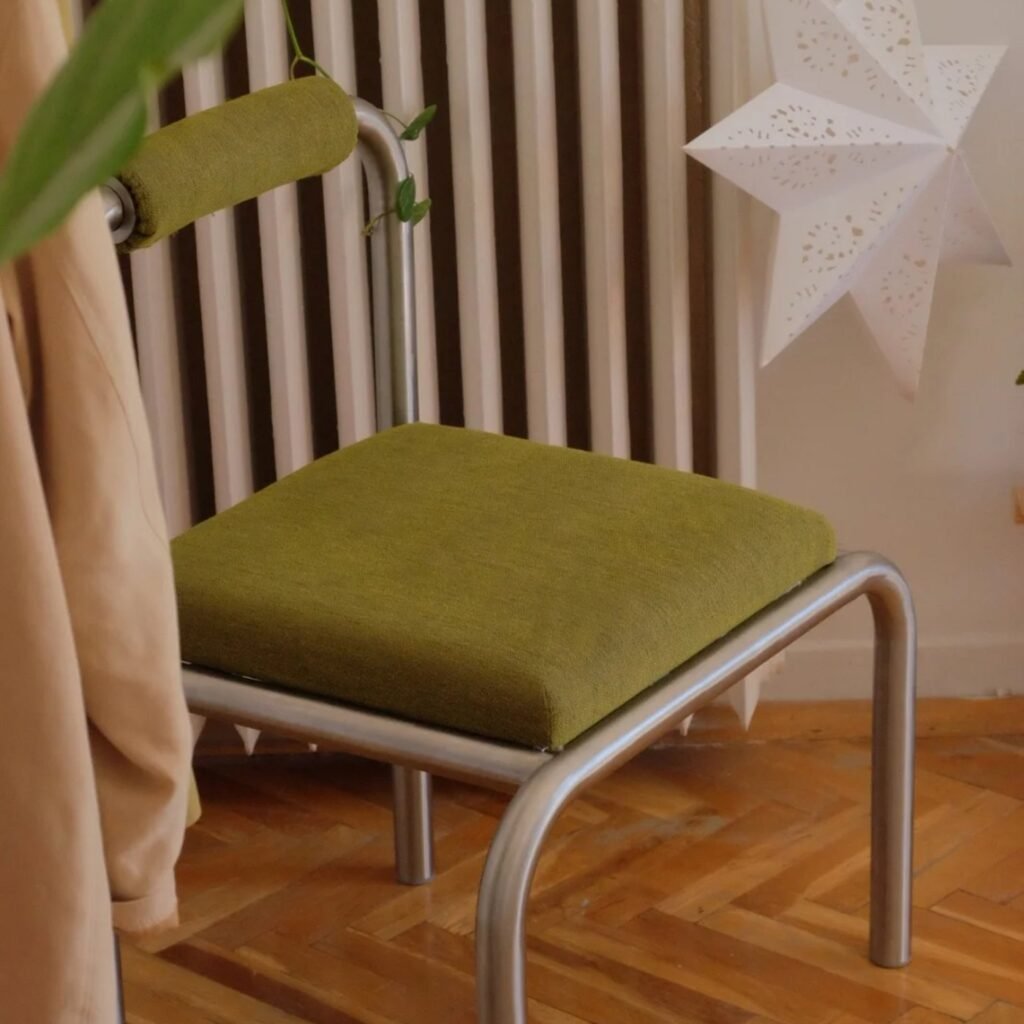
This is the most common objection to stainless steel furniture, and there is something to it. Steel conducts heat quickly, so it feels cool on first contact. The answer lies in the design itself: when the seat and back are upholstered, every point of contact meets fabric and the metal reads as structure.
Move Chair is the clearest example of that balance. Backrest height 73 cm, seat height 44.5 cm, depth 45 cm, and every surface you sit on covered in nubuck or woven fabric. Bold Chair builds the same logic in a more generous silhouette: 80 cm backrest height, 49 cm seat height, 50 cm seat depth and 66 cm width.
Why the measurements matter
When choosing a chair, dimensions determine lifespan as much as material does, because the wrong dimension means the piece goes unused. A standard dining table stands between 74 and 76 cm high. A chair with a seat height between 44 and 47 cm leaves comfortable knee clearance. Move Chair at 44.5 cm and Bold Chair at 49 cm represent the two ends of that range: the first a lower, more relaxed sit, the second a more upright and generous stance.
So which one?
The honest answer: a wooden chair in a dry, stable interior, well jointed, can serve for generations. Stainless steel is the material that asks for less maintenance and forgives more when moisture, staining and heavy use are in play. Kitchen islands, hospitality spaces, hard-working dining tables and humid climates are where stainless steel belongs.
Our guides to what stainless steel is and to chrome, satin and polished finishes cover the material and surface side.
Frequently asked questions
Is a stainless steel chair heavy?
Stainless steel has a density of 7,900 kg/m³, considerably denser than wood. But furniture uses thin-walled tube, so the total weight comes from the tube section rather than a solid body. The result is a solid piece that can still be moved.
Can a scratched steel chair be repaired?
Shallow scratches, especially on a satin finish, can largely be worked out along the direction of the grain. The same is not possible on a plated product.
Is a wooden chair more sustainable?
Not by itself. Wood is a renewable resource, but glue and finish layers make end-of-life separation harder. Stainless steel is not renewable, yet it can be fully recycled without losing its properties.
Sources: USDA Forest Products Laboratory, Wood Handbook: Wood as an Engineering Material; worldstainless, Recycling