How a Chair Is Made in the Workshop: From Prototype to Delivery
How a Chair Is Made in the Workshop
A stainless steel chair passes through drawing, prototype, tube cutting and bending, welding, surface finishing, upholstery and quality control, in that order. Each step sets the error margin of the next. A two-degree deviation in a bend becomes five millimetres at the weld, and a stress left uncorrected at the weld becomes a wobble you feel when you sit down.
1. Drawing and decisions
Everything begins with dimensions. Seat height, depth, backrest angle and leg spread are linked variables, and changing one means recalculating the others. Because a standard dining table stands 74 to 76 cm high, seat height usually lands between 44 and 47 cm. Move Chair sits at 44.5 cm in that range, Bold Chair at 49 cm for a more upright stance.
Material is fixed at this stage too. Once 304 stainless steel tube is chosen for the body, the tube diameter and wall thickness determine both the strength and the tightest radius that can be bent. If the curve in the drawing is sharper than the physical limit of the bend, the drawing changes, not the machine.
2. Prototype
A form that looks right on screen can be wrong to sit in. That is what a prototype is for. When the first example is made, what gets examined is not appearance but behaviour: how weight distributes, where the back makes contact, whether the leg spread hits the table, whether the chair tips as you stand up.
Every change made at prototype stage is cheap. The same change after production has started comes back as tooling, scrap and time. Lean prototyping aims at exactly this, and our article on lean prototyping goes into the detail.
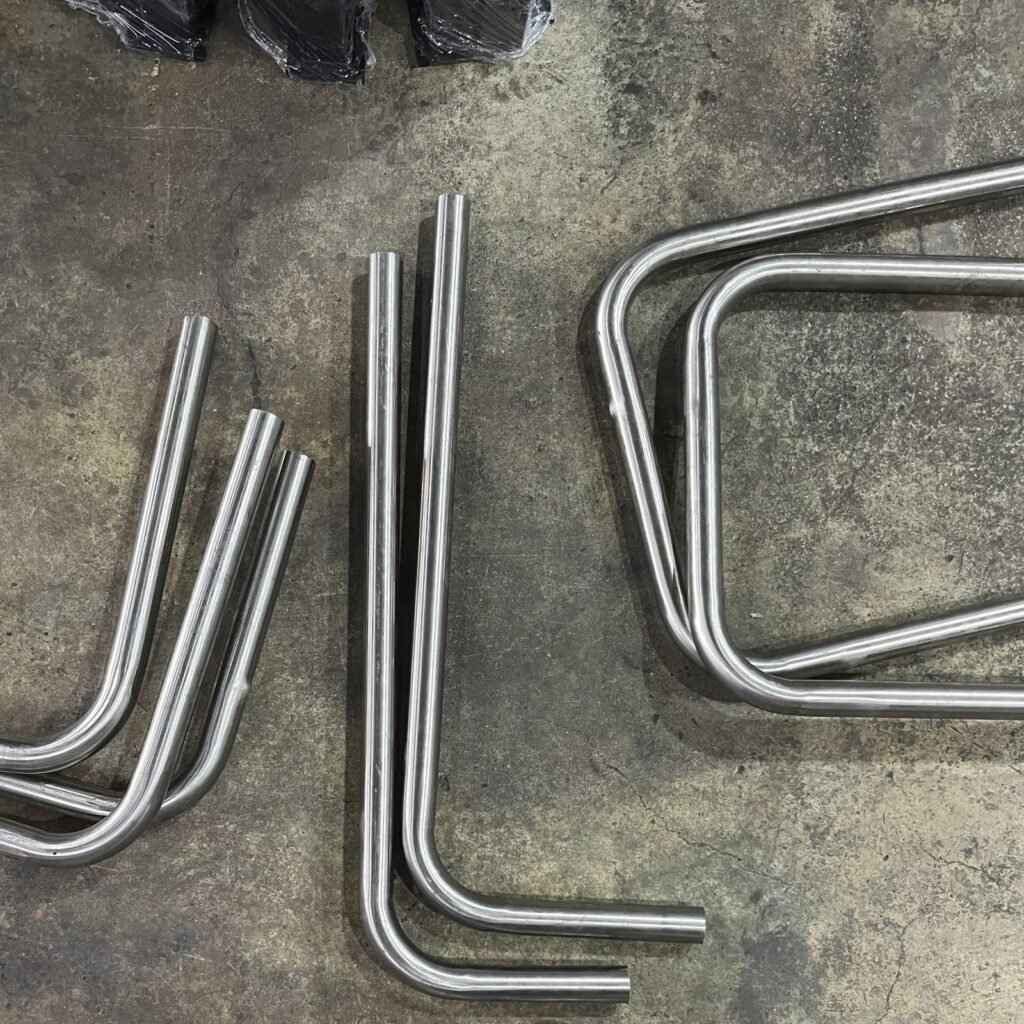
3. Cutting and bending
Tube is cut to the developed length from the drawing. Developed length is not the sum of the straight sections, because during bending the outside of the material stretches while the inside compresses. Ignore that difference and the finished part comes out several centimetres short or long.
Bending is one of the most skill-dependent steps in furniture making. Stainless steel springs back slightly after bending, so a 90 degree corner needs more than 90 degrees of bend, with an allowance for springback. That allowance varies with the batch, the wall thickness and the bend radius, which is why every new production run is verified with a test piece.
4. Welding and cleaning up
The parts are joined by welding. Welding stainless steel is delicate for two reasons. First, heat locally changes the structure of the material, and uncontrolled heat can reduce corrosion resistance. Capping carbon at 0.08% in 304 exists precisely to reduce that risk.
Second, appearance. If the weld bead is not ground back flush with the surface, the joint is visible. The whole effect of an uninterrupted form lives in that grinding and dressing work. On a piece like Mobo Bench, with an uninterrupted body across 100 cm, this step takes far more of the production time than it appears to.
5. Surface finishing
After welding and grinding, the surface is brought to a single character. A satin finish is made of fine directional lines produced by mechanical brushing, and it breaks light softly. A polished finish is achieved through progressive polishing stages and takes the surface close to a mirror. Our article on chrome, satin and polished finishes covers the difference and what it means day to day.
A mistake at this step cannot be hidden later. On a painted product a surface flaw disappears under the paint. On stainless steel the surface is the finished product.
6. Upholstery
On upholstered models, foam and fabric arrive at this stage. Fabric tension, seam placement and how the corners are folded affect seating comfort directly. Cohoo uses nubuck, woven and linen-textured fabrics. This is exactly where the coolness of metal is balanced: every surface you sit on meets fabric, and the metal reads as structure.
7. Quality control and delivery
At the last step four things are checked: all four feet in the same plane, the integrity of the welds, no marks left on the surface, and symmetry in the upholstery. A chair that rocks on a flat floor is the sum of tolerances accumulated at any step of production, and it goes back.
Cohoo products are delivered roughly 20 working days after the order is placed. That is not a shipping time from stock, it is the time the piece needs to pass through these steps.
Frequently asked questions
Why make to order rather than hold stock?
Colour, upholstery and finish options combine into dozens of variants of a single model. Holding all of them is both costly and wasteful. Made to order delivers the piece in exactly the specification chosen.
Is every chair identical?
The dimensions are. Because grinding and upholstery are done by hand, there can be very small differences in the surface. That is not a defect, it is the nature of handwork.
Why 20 working days?
Bending, welding, surface finishing and upholstery each carry their own preparation and waiting time. Shortening the schedule usually means skipping a step, and that comes out of the product’s lifespan.
Sources: TWI, Avoiding heat tint during welding of stainless steels; Euro Inox, Pickling and passivating stainless steel